
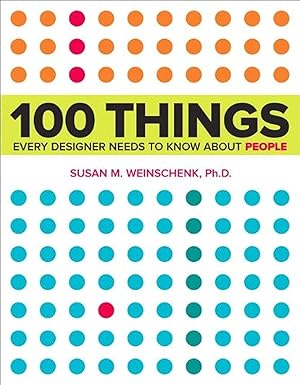
Why Susan Weinschenk’s “100 Things Every Designer Needs to Know About People” Changed How I Approach Web Design
When I opened Susan M. Weinschenk’s 100 Things Every Designer Needs to Know About People, I expected another design coffee-table book filled with pretty screenshots and surface-level advice. Instead, I found something far more valuable: a research-backed dismantling of design mythology that the industry has perpetuated for years.
As someone who builds WordPress websites and designs digital experiences, I’ve absorbed countless “best practices” that feel universally true. Capitalize headings? Yes. Minimize clicks to conversion? Of course. Use mixed-case text because uppercase is harder to read? Absolutely—everyone knows that. But Weinschenk’s book, grounded in academic psychology research and behavioral science, reveals something uncomfortable: much of what we “know” about design is incomplete, oversimplified, or outright wrong.
The Book That Actually Uses Science
What immediately impressed me about Weinschenk’s work is her methodology. She didn’t write from intuition or anecdotal design experience. Instead, she spent months reading “lots and lots of research”—her own words—reviewing dozens of books and hundreds of peer-reviewed research articles. Then she combined these evidence-based insights with her 20+ years of designing technology interfaces. The result is 100 concise, actionable principles organized into chapters covering how people see, read, remember, think, make decisions, and feel.
Each principle is presented in 1-2 pages, typically opening with a relatable real-world scenario, supported by research citations, visual examples, and concrete design takeaways. It’s the opposite of fluff—every page earns its space.
The Capitalization Myth That Broke My Assumptions
Let me start with the claim that made me question everything else: the all-caps myth (Principle #13: “It’s a Myth That Capital Letters Are Inherently Hard to Read”).
For years, I’ve heard the conventional wisdom: ALL CAPS are harder to read because they form uniform rectangles, and readers recognize words by their shapes, not individual letters. This theory has been gospel in design circles. Weinschenk cites the actual research, and here’s the problem: that theory dates back to 1886, and it’s wrong.
Modern research shows we don’t recognize words by shape. Instead, we recognize and anticipate individual letters in sequence—what’s called parallel letter recognition. When researchers (Paap, 1984; Rayner, 1998) tested reading speed with uppercase text, they found that uppercase is slower, but only because people aren’t accustomed to it. With practice, speed matches mixed-case text.
Why does this matter for WordPress designers? It doesn’t mean you should suddenly write your entire website in caps. People perceive all-caps as “shouting,” and the unfamiliarity creates cognitive friction. But it kills the myth that uppercase letters are somehow inherently harder to parse. Understanding the why—familiarity, not neurological limitation—opens new design possibilities.
The Navigation Myth: Not All Clicks Are Equal
Now let’s address the obsession with minimizing clicks. In web design, we treat each click like currency. Reduce clicks. Flatten hierarchies. The assumption: more clicks = worse user experience. But Weinschenk’s research suggests the relationship is far more nuanced.
The book dives deep into how people actually perceive web pages (Chapter 2: How People See), and here’s where it gets fascinating. Peripheral vision is far more important than most designers realize. Weinschenk cites Kansas State University research showing that while central vision identifies specific objects, peripheral vision captures the “gist” of an entire scene. People decide what a page is about from their peripheral vision in milliseconds, often before they consciously read anything.
What does this mean for your WordPress site? It’s not the number of clicks that matters most—it’s whether users can quickly understand the purpose and hierarchy of your page. A well-designed navigation system that takes an extra click is far superior to a flat menu that confuses users about where to find information.
This is supported by the principle of mental models (Principle #31): people have preconceived notions of where things “should” be. If your navigation violates their expectations, no amount of click-reduction will save you.
Eye-Tracking Doesn’t Tell the Whole Story
Weinschenk also addresses a subtle but crucial limitation in how we validate design decisions: eye-tracking data is often misinterpreted (Principle #8: “People Can Miss Changes in Their Visual Fields”).
Eye-tracking is a powerful tool—it measures where someone’s foveal (central) gaze is focused. The problem? It doesn’t measure attention. People’s eyes can look directly at something without consciously perceiving it. Weinschenk references the famous Gorilla experiment by Christopher Chabris and Daniel Simons: when people watch a basketball video while counting passes, about 50% miss a person in a gorilla costume walking across the screen—even though their eyes physically look at the gorilla.
The implication for web design is humbling: just because your eye-tracking study shows users look at a certain button doesn’t mean they actually see it or understand its purpose. Context, expectation, and attention matter as much as where the eye lands.
The Deeper Truth About Motivation and Engagement
Beyond debunking myths, Weinschenk offers profound insights into human motivation that reshape how we design experiences. Principle #50 (People Are More Motivated as They Get Closer to a Goal) introduces the goal-gradient effect.
Research from 1934 showed that rats running a maze toward food accelerated their pace as they neared the end. Modern studies by Ran Kivetz confirm humans do the same. This is why progress bars, loyalty cards with visible progress, and achievement milestones work so well.
Even more interesting: people are MORE motivated by the illusion of progress. In Kivetz’s coffee shop study, customers with a frequent-buyer card that started with two boxes pre-stamped completed their card faster than those starting with a blank card—even though both required the same number of purchases. The perceived progress was motivating enough to change behavior.
For WordPress e-commerce sites, this is golden. A checkout progress indicator showing “Step 2 of 4” isn’t just UX; it’s motivation design. It taps into deeply rooted human psychology.
Variable Rewards and the Casino Effect
Principle #51 (Variable Rewards Are Powerful) ventures into operant conditioning—Skinner’s work on reinforcement schedules. This is where design intersects with behavioral psychology in ways that feel almost manipulative (and ethically, deserves careful consideration).
Weinschenk explains four types of reinforcement schedules: fixed interval, variable interval, fixed ratio, and variable ratio. The variable ratio schedule—where you don’t know exactly when the reward comes, but the odds improve with each attempt—is the most addictive. It’s how slot machines work.
Understanding this matters not because you should design deceptive websites, but because it reveals how engagement systems actually function. If you’re building a WordPress site with gamification, user rewards, or social features, knowing that variable rewards create stronger engagement than predictable rewards is essential. The question is whether you use this knowledge ethically.
What Makes This Book Different From Other Design Reads
In an industry saturated with design books, 100 Things Every Designer Needs to Know About People stands out for several reasons:
1. Research-Driven, Not Opinion-Based
Every principle is backed by citations. Weinschenk doesn’t just assert; she references academic sources. If you dig into the bibliography (it’s extensive), you can verify and explore further.
2. Myth-Busting Instead of Rule-Giving
Rather than prescriptive “do this” advice, Weinschenk often starts by dismantling false beliefs. This approach is more intellectually honest and more useful—it teaches you how to think about design problems rather than giving you templates.
3. Practical Without Being Shallow
The takeaways at the end of each section are immediately applicable to WordPress sites, web apps, and digital products. But they’re never simplistic. Each principle forces you to think deeper about trade-offs and context.
4. Breadth Across Human Cognition
The book covers vision, memory, attention, motivation, emotion, decision-making, and social behavior. It’s not just “web design best practices”—it’s a mini-course in applied psychology for designers.
How This Book Changes Your Design Process
Since reading Weinschenk, my approach to design decisions has fundamentally shifted. Instead of asking “What does best practice say?” I now ask “What does human cognition actually support?”
This leads to different conversations with clients:
- On navigation complexity: “We might need an extra click, but if it matches how users mentally model the site, they’ll actually navigate faster and feel more confident.”
- On text formatting: “We don’t need to avoid caps; we need to use them strategically where they work for attention or hierarchy, not avoid them blindly.”
- On call-to-action buttons: “This button needs visual cues showing it’s clickable—not just color and text.”
- On progress and goals: “Every step toward conversion should be visible. Even the illusion of progress motivates users to continue.”
Should You Read It?
If you build websites, design user experiences, or care about why people behave the way they do online, yes. Absolutely.
The book isn’t long—about 300 pages—but it’s information-dense. You won’t read it cover-to-cover in an evening. Instead, it works best as a reference guide you return to when designing specific features or troubleshooting user behavior problems.
It’s also available in a follow-up edition: 100 More Things Every Designer Needs to Know About People (2016), which expands on topics like interface design, embodied cognition, and diversity.
The Bigger Picture
What I appreciate most about Weinschenk’s work is that it advocates for designing with people, not for assumptions about people. So much of design thinking—in WordPress customization, e-commerce, SaaS interfaces—is based on what stakeholders believe users want, not what research actually shows.
By grounding design in behavioral science, Weinschenk empowers designers to make stronger arguments, ask better questions, and create experiences that respect how human cognition actually works.
In a field where trends change every season and “best practices” are constantly updated, it’s refreshing to read something rooted in timeless principles about how humans perceive, think, and decide. That’s the real value of this book: it’s not about what’s trendy in design. It’s about what works because of how brains work.
Have you read Weinschenk’s book? What principle surprised you most? What design myth have you held on to that this research challenges? Share your thoughts in the comments—I’d love to know which insights resonated with your own design practice.
Leave a Reply